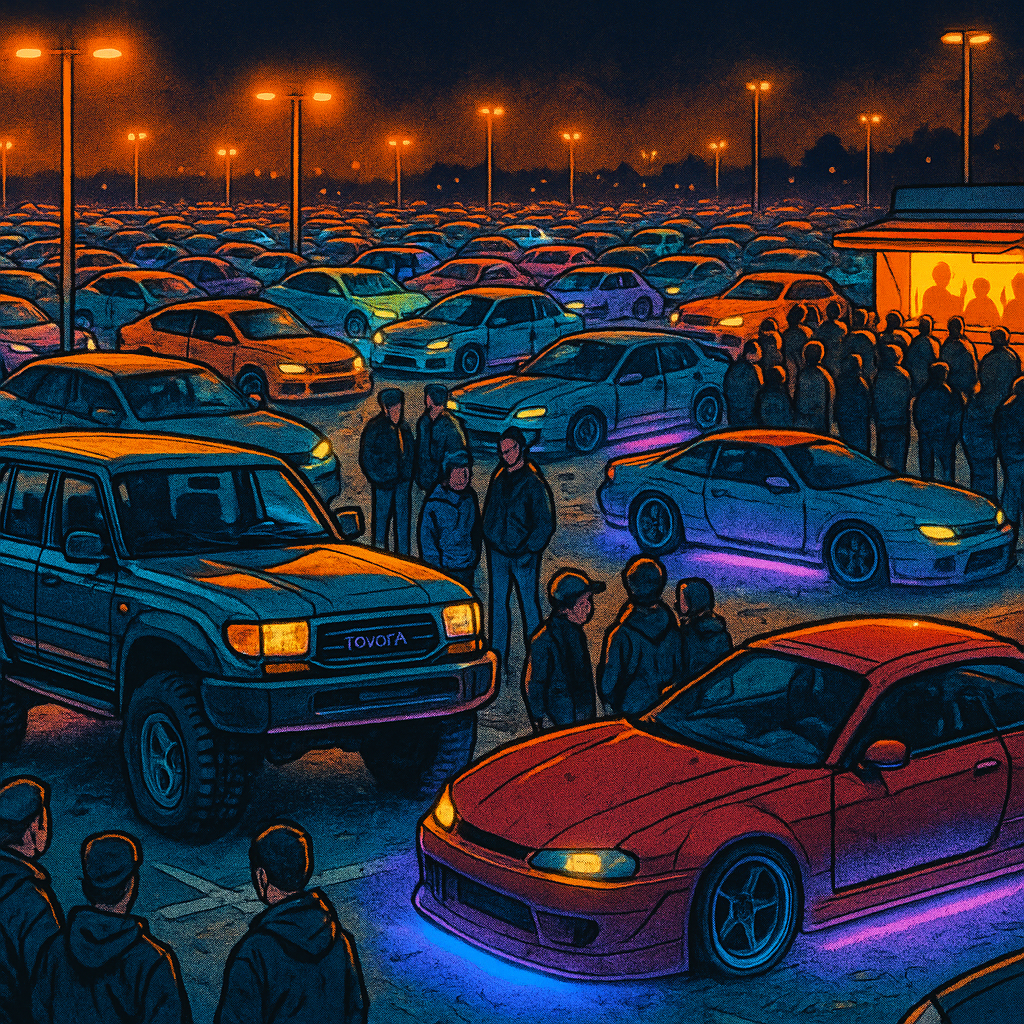
Something shifted quietly over the last couple of years, and if you’ve been paying attention on the UK car scene, you’ll have clocked it. The retail park meet is dying. Not dead, but dying. Slowly being replaced by something grittier, more intentional, and honestly a lot more interesting: the industrial estate gathering. I’ve been to both ends of this spectrum recently, from a fluorescent-lit Lidl car park in Coventry to a proper organised unit-yard meet in Trafford, and the contrast is jarring. One feels like a school corridor. The other feels like a scene.

The UK car meet industrial estate 2026 phenomenon isn’t random. There’s a logic to it, rooted in planning, policing, permission and pride. Understanding why it’s happening tells you a lot about where British car culture is actually heading.
What killed the retail park meet?
Retail parks were always a compromise. Flat tarmac, easy access off a dual carriageway, open late. For a long time that was enough. But shopping centres and retail landlords have quietly turned hostile. CCTV systems got smarter. Security companies got briefed harder. And after a string of incidents nationally, including some genuinely dangerous driving at informal gatherings in the West Midlands and South Yorkshire in 2024, councils started leaning on private landowners to lock things down.
By early 2026, a number of well-known meet spots had either been gated off on weekend evenings or had active security turning people away on arrival. The Trafford Centre car park situation is a good example. What used to be a loose gathering point became untenable after a serious incident, and now the venue actively discourages it. Same story at several major retail parks around Bristol and the M25 corridor.
Motorway services were always less stable anyway. With UK petrol prices doing what they’ve done through 2026, the pilgrimage to a distant service station for a £2.80 coffee and a gawp at someone’s Supra started feeling pointless. The economics changed. The tolerance from operators changed with them.
Why industrial estates work so well for car culture
The shift to trading estates isn’t just displacement. It’s an upgrade in almost every practical sense. Here’s what I’ve noticed after attending half a dozen properly organised unit-yard meets this year.
First, the space is actually usable. Wide service roads, turning circles, loading bays repurposed as display areas. Vehicles can be spread out properly. You get a proper look at builds without squeezing past someone’s wing mirror. Second, industrial units are usually quiet at weekends. No residents kicking off, no shoppers trying to get to B&M, no delivery lorries. Just cars and people who want to be there.
Third, and this is the big one: it’s far easier to get formal permission. A unit owner or estate management company can grant a one-off licence for use of the grounds on a Saturday evening. It’s a commercial transaction. Organisers pay a hire fee, get keys, get a contact number. That paper trail means the meet is legal, insured, and defensible if the police roll up. Which they sometimes do, but increasingly just to have a look rather than break it up.
How organisers are keeping things legal in 2026
The best-run UK car meet industrial estate events in 2026 look nothing like the chaotic free-for-alls of five years ago. There’s a proper organiser structure now. WhatsApp groups with clear entry rules. Wristbands sometimes. A designated contact for the venue. Traffic marshals, often volunteers from within the club, managing the entrance flow.
I spoke to one organiser who runs quarterly meets on an estate near Sheffield’s Lower Don Valley. He told me the whole thing costs around £400 to hire the yard for six hours. Split across entry contributions of £3 to £5 per car, a meet of 100-plus vehicles more than covers it, with leftover funds going toward a charity pot or a future venue deposit. Clean, transparent, accountable.
The legal angle matters more than it used to. The conversation around informal UK car gathering spots and the law has been evolving fast, and organisers who don’t have proper permissions are increasingly exposed. Police in several forces have used antisocial behaviour legislation to disperse unplanned gatherings, and a couple of seizures of vehicles in 2025 sent a clear message. Getting a piece of paper sorted isn’t bureaucratic box-ticking anymore. It’s self-preservation.
What this says about UK car culture right now
I think the move to industrial estates reflects genuine maturity in the scene. Not maturity in the boring, sanitised sense. Maturity in the sense that people who care about car culture want to protect it, and they’ve realised that legitimacy is the shield.
The builds you see at these estate meets are wilder too. Without the nervousness of a retail park security confrontation, people bring cars they’d never have dragged out before. I’ve seen everything from full-send track prep’d Civics to stanced E46s to legitimate RHD grey imports that would turn heads anywhere. The creative energy that’s been brewing in the UK’s city car scenes is finding a proper home in these kinds of spaces.
There’s also a community layer that retail parks never had. Because industrial estate meets require active organising, they attract people who are genuinely invested. Newcomers get welcomed properly. There’s usually food sorted, sometimes a local trader or a mate with a van doing wraps and loaded fries. The social fabric of these events is tighter. You leave knowing people’s names rather than just their number plates.
The Public Order Act and related antisocial behaviour legislation that organisers now navigate has, paradoxically, pushed the best of the scene toward better-organised events. The barrier to casual, chaotic meets got higher, which filtered out a lot of the drama. That’s not a bad trade.
The future of UK meets isn’t retail parks or motorway services
If the trajectory holds, and I think it will, the industrial estate model becomes the default for serious UK car gatherings within a few years. Some of the bigger estates are already in conversations with promoters about regular monthly slots. One venue near Manchester’s MediaCityUK area is reportedly looking at a weekly Friday evening slot with fixed infrastructure, power points for electric car charging, and a permanent food trader arrangement.
That’s not selling out. That’s the scene growing up without losing its edge. The cars are still mad, the people still passionate, the atmosphere still charged. It just doesn’t end with a dispersal notice anymore. For UK car culture, that’s progress.